
Why Clutter Feels So Personal
and What Science Says About It
Winning Move: Stop Playing
For decades, consumer culture has encouraged us to believe that more is better: more possessions, more convenience, more proof that we are doing well. Malcolm Forbes captured that mindset in the familiar phrase, “He who dies with the most toys wins.”
But homes filled beyond their capacity tell a different story.
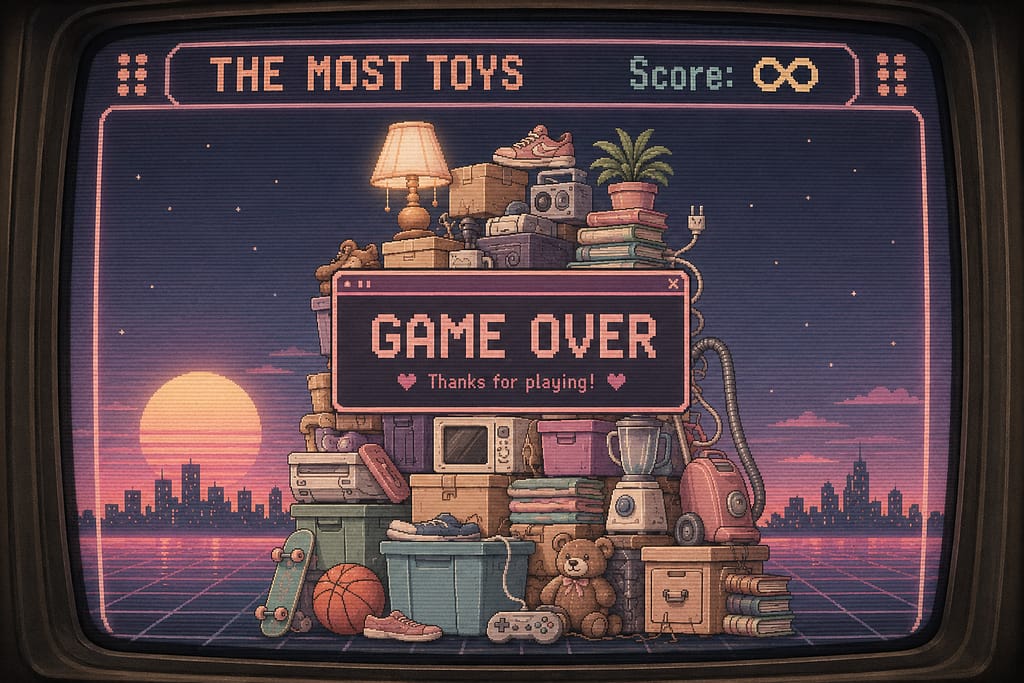
Our possessions are not emotionally neutral. We use them to express identity, preserve memories, signal achievement, and create a sense of belonging. That helps explain why letting go can feel surprisingly personal. Yet when our belongings begin to overwhelm our space, the things meant to represent us can make it harder to recognize ourselves.

Research suggests that clutter can compete for our attention, reduce our ability to focus, and make the home feel stressful rather than restorative. It may affect sleep, eating habits, relationships, and our sense of control. The problem is not simply that a room looks untidy. Clutter can become a constant visual reminder of unfinished decisions, unmet expectations, and a life that no longer feels fully our own.
Decluttering, then, is not merely an exercise in making things look nicer. It can be a way of reclaiming attention and restoring a sense of agency. Cleaning and organizing offer visible, immediate results. They allow us to shape our surroundings deliberately rather than feeling shaped by them.
But there is a larger question beneath the practical work of organizing: how did so many of us acquire more than we can comfortably use, maintain, or enjoy?

The contest promised by “He who dies with the most toys wins” has no clear finish line. There is always another upgrade, another trend, another object that promises to make us happier, more successful, or more complete. Even when we organize everything perfectly, the cycle begins again if we continue measuring well-being through acquisition.
That is where the lesson from WarGames becomes useful. Faced with a game that cannot truly be won, the computer reaches a simple conclusion:
“The only winning move is not to play.”
-Joshua, WarGames (1983)

Stepping out of the game does not require rejecting every possession or living in an empty home. It means becoming more intentional about what we invite into our lives. It means asking whether an object supports the person we are—or merely reflects a cultural message we have absorbed.
The goal is not perfection. It is a home that helps us feel safe, capable, rested, and recognizably ourselves.
Decluttering can help us rise out of the physical accumulation. Choosing not to return automatically to the cycle of accumulation is how we remain free.